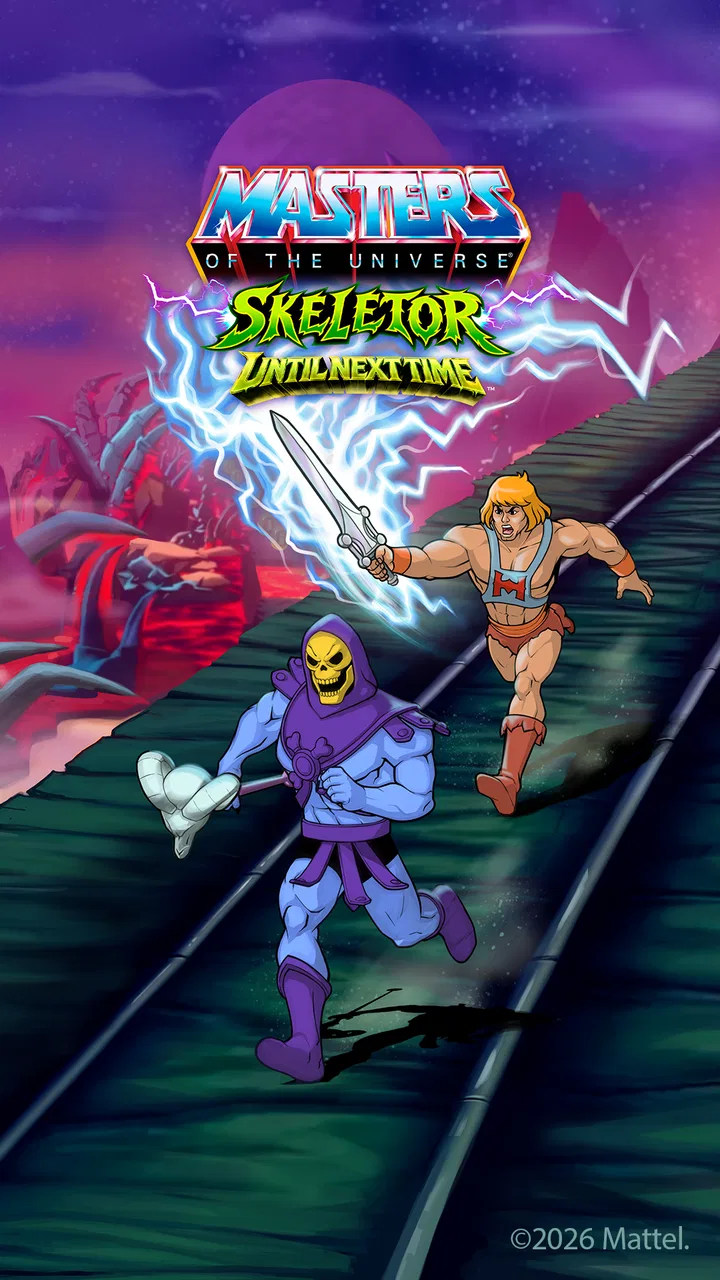
MOTU Skeletor: Until Next Time
- 4.7
- Rating
- 50.00K
- Installs
- Free
- Price

 Analysis by App-foxy
I approached MOTU Skeletor: Until Next Time as a quick action game rather than a large, story-heavy adventure, and that expectation made a real difference. Its identity is clear from the start: this is a Masters of the Universe runner built around Skeletor, designed for short bursts of play and easy access. I found the appeal strongest when I wanted something immediate, familiar, and simple to pick up without committing to a long session.
That focus is also the game's main limitation. It does not appear aimed at players looking for a deep action system, a broad role-playing experience, or a substantial campaign. Instead, it works best as a compact mobile diversion with a recognizable character at its center. Mattel Game Studios keeps the concept direct, and the free entry point makes it easy to try, although the presence of in-app purchases means I would still approach it with some caution if I were setting it up for a younger player.
What the Skeletor runner gets right
The most convincing part of the experience is its clarity. A runner needs to communicate quickly, and a Skeletor-focused game has an immediate visual and thematic hook. I never had to wonder what the game was trying to be. It belongs to the action category, but it does not bury that action beneath complicated menus or a long explanation. That makes it a natural choice for a few minutes of play while waiting for an appointment, taking a break, or relaxing after a busy day.
You May Also Like

 AccuWeather: Weather Radar
AccuWeather Review: A Quick, Clear Forecast for Everyday Decisions
For everyday plans, the best forecast is the one you can understand quickly. AccuWeather makes rain timing, radar, and local conditions easy to act on, with a few trade-offs.

 Hill Climb Racing
Why Hill Climb Racing Still Turns Crashes Into One More Run
A tiny car, a bumpy hill and one more upgrade: Hill Climb Racing keeps resurfacing because its simple chaos makes every near-miss feel personal.

 AliExpress - Shopping App
AliExpress Makes Global Shopping Feel Personal, but Shoppers Bear the Risk
AliExpress turns a global marketplace into a pocket-sized discovery engine. Its reach is useful, its shopping loop compelling, and its trade-offs easy to miss.

 Lords Mobile: Kingdom Wars
Lords Mobile Is a Kingdom-Building Routine, Not a Quick Match
A case-by-case verdict on the building, battles, device demands, and social commitments that make Lords Mobile rewarding for some players and exhausting for others.

 PDF Scanner app - TapScanner
TapScanner Makes Paperwork Easier to Capture, Check, and Share
TapScanner makes scanning with a phone feel less like a rescue operation and more like a dependable step in getting work done. Its capture tools are useful, though not flawless.

 Block Blast!
 Shows How Much a Puzzle Game Can Leave Out
A quiet grid game shows why puzzle players increasingly value instant clarity, repeatable skill and low-pressure play—and where the genre still needs to catch up.
More From Our News Desk
View All News


The Masters of the Universe connection gives the game more personality than an anonymous endless-runner concept. Skeletor is not just a generic avatar placed into an interchangeable obstacle course; his presence supplies the attitude and recognizable flavor that will matter most to fans of the character. Even if someone has never spent much time with the wider franchise, the villain-centered premise is easy to understand and gives the game a more distinctive starting point than many quick mobile action titles.
I also appreciate that the game is free to start. That matters for this type of release because the best way to judge a runner is to play it personally. A free download removes the initial commitment and lets you decide whether the controls, pacing, and presentation suit you. The current version is 0.2.7, which also suggests that players should view the experience as an evolving release rather than assuming it has the depth or polish of a long-established premium game.
The audience response is encouraging without being something I would treat as a guarantee. It holds a 4.7 average from around 128 ratings, with roughly 13 written reviews, and the game has passed 50 thousand installs. Those figures show that early players have reacted positively, but the relatively modest scale means I would still make my own decision based on the actual feel of the game rather than relying on the score alone.
Why short sessions suit it
Runner games are at their best when they fit naturally into ordinary routines, and this one has that advantage. I can imagine opening it during a short commute break, playing a few attempts, and closing it without needing to remember a complicated plot or rebuild a strategy from the previous session. That low-friction structure is particularly useful for players who want action but do not have the time or patience for a full console-style session.
A practical approach is to treat each attempt as a small test of timing rather than immediately chasing a perfect result. I would first concentrate on learning how Skeletor responds to input and how quickly the game expects decisions. Once the movement feels familiar, I would focus on building consistency instead of making risky choices for a slightly better run. That habit is more useful in a runner than repeatedly restarting without understanding why an attempt failed.
Another useful way to play is to separate casual sessions from improvement sessions. In a casual session, I would simply enjoy the character and stop when the game starts to feel repetitive. In an improvement session, I would pay attention to the exact moment a mistake happens: late reaction, poor positioning, or an overly ambitious move. This makes the game feel less random and gives short play periods a clearer purpose.
That distinction also helps explain who may enjoy it. Players who like repeating compact action challenges can find a satisfying loop here, especially if the Skeletor theme is already appealing. Players who need constant progression, extensive customization, or a strong narrative may find the same structure too narrow. The game’s value depends heavily on whether the act of replaying a run is enjoyable in itself.
The character theme is more than decoration
The Skeletor focus gives the game a tone that a standard runner cannot easily reproduce. The character brings a mischievous villain energy, and that makes the experience feel more playful than a purely abstract obstacle game. For a fan, this can be the reason to return even when the underlying format is familiar. The theme provides emotional context to a genre that often relies only on speed and score.
At the same time, I would not recommend downloading it solely because of the franchise name. A recognizable character can make the first session more interesting, but it cannot replace responsive controls or a satisfying rhythm. If you usually lose interest in runners after a few attempts, Skeletor alone may not change that habit. The strongest case for the game is the combination of the character and the quick action format, not the license in isolation.
There is also a useful trade-off here. A focused character game can be easier to understand than a larger Masters of the Universe title with many systems competing for attention. The downside is that a narrower concept may feel less substantial once the novelty wears off. I would therefore see this as a companion game for brief entertainment, not as the one mobile game meant to represent the entire universe.
Where the experience may lose momentum
The clearest weakness is the risk of repetition. Runner games naturally ask the player to repeat similar actions, and that can be enjoyable only while the challenge continues to feel meaningful. If you prefer carefully designed levels with a definite ending, a tactical combat system, or a campaign that steadily changes its rules, this format may feel limited. I would choose a conventional action platformer instead when I wanted exploration and a stronger sense of progression.
The early version number is relevant to that judgment. At 0.2.7, I would keep expectations measured and allow for a more compact feature set than I might expect from a mature release. That does not make the game unsuitable, but it does affect how I evaluate it: the basic loop needs to be fun on its own, because I would not download it expecting a fully developed long-form adventure.
The free model is convenient, but the in-app purchase range runs from $0.99 to $99.99 per item. I would not assume that spending is necessary to enjoy the game, yet I would still review the purchase settings before handing the device to a child. The age rating is Everyone 10+, and that makes the game accessible to a broad audience, but accessibility does not remove the need for sensible purchase controls. For family use, I would treat the free download and the purchase system as two separate decisions.
There is a psychological trap common to score-based games: a player can start chasing a better attempt simply because the previous one ended badly. I found it more enjoyable to set a personal stopping point before beginning. For example, I might play until I complete a handful of focused attempts, then leave the game rather than continuing out of frustration. That small boundary keeps the runner in the role of entertainment instead of turning it into an irritating test of patience.
Who should skip it
I would skip this game if my main reason for downloading were the expectation of a substantial story. The store summary presents it as a Masters of the Universe action runner, and that description points toward a focused arcade-style experience rather than a narrative campaign. Someone searching for character conversations, world exploration, or a long sequence of missions should look for a different type of action game.
I would also be cautious if I disliked free-to-play structures in general. Even when a game is enjoyable without spending, the existence of optional purchases can change how comfortable the experience feels. Players who want a single upfront purchase and no purchase prompts may be happier with a premium action title. That alternative is especially sensible for anyone who wants to eliminate financial distractions during casual play.
Finally, fans who want a broad roster or a complete tour of the Masters of the Universe world may find the Skeletor-centered approach too specific. The focused theme is a strength for people who like the character, but it is not the same as a full franchise showcase. I would recommend it to someone who wants a quick Skeletor game, not to someone expecting every favorite character or storyline to receive equal attention.
How I would use it day to day
My ideal use case is a short evening break. I would open the game after finishing a task, play a few runs while listening to something in the background, and stop once the action stopped feeling fresh. That works because the game does not demand a large block of uninterrupted time. It also avoids the commitment of a competitive multiplayer match, where leaving early can affect other players.
For a younger player, I would introduce it with clear boundaries: check the age rating, review the purchase controls, and agree on a session length. The Everyone 10+ rating makes it broadly approachable, but the purchase range is still worth discussing with the person using the device. I would also encourage playing for the challenge rather than treating every failed run as a reason to buy something or continue indefinitely.
For a fan of Skeletor, I would suggest giving the game a fair trial over several short sessions instead of judging it after one attempt. The first session tells you whether the controls feel natural, while later sessions reveal whether the repeatable action has enough appeal to bring you back. That is a more honest test than assuming the character theme will carry the entire experience.
On a device running Android 8.1 or later, the technical entry requirement is relatively approachable for users with older compatible phones. I would still keep the usual practical habits for mobile gaming: close unnecessary apps if performance feels uneven, keep enough storage available for updates, and avoid playing when the screen or controls are uncomfortable. Those steps are not unique to this title, but they matter more in a runner because a small delay can affect a quick reaction.
My comparison with familiar alternatives
Compared with a traditional platform action game, this title is easier to begin but likely offers less room for exploration. A platformer rewards learning a level’s layout and discovering what lies beyond the next screen. A runner instead emphasizes immediate reactions and repeated attempts. I would pick the Skeletor game when I wanted fast access, and a platformer when I wanted a journey with a clear destination.
Compared with a large licensed action game, it has a more concentrated identity. Bigger titles may provide more characters, equipment, missions, or story content, but they also ask for more time and attention. This game makes a better companion for a phone than a substitute for a full-scale franchise adventure. Its strength is not breadth; it is the ability to turn one recognizable character into a compact action loop.
It also differs from multiplayer action games because the pressure is more personal. I can focus on improving my own timing without dealing with teammates, opponents, or a fixed match schedule. That is a real advantage for quiet solo play. The trade-off is that there is less social variety, so players who stay motivated through competition may prefer a game with live matches or shared progression.
One of my more practical recommendations is to decide what kind of satisfaction I want before opening it. If I want a quick reaction challenge, the runner format makes sense. If I want to unlock a large collection, build a character, or follow a detailed plot, I should choose another game instead of expecting this one to become something it was not designed to be. That simple expectation check prevents most disappointment.
My verdict on the Skeletor-led action game
MOTU Skeletor: Until Next Time is most successful as a focused, free-to-start action runner with a recognizable villain at its center. I like the direct concept, the suitability for short sessions, and the way the Masters of the Universe identity gives a familiar format extra character. Its 4.7 average and growing install base suggest a promising early reception, though I would still judge it by the repeatability of its core action rather than by the rating alone.
The limitations are equally clear. The runner structure may become repetitive for players who need deep progression, and the early version means I would approach it as a developing experience. The purchase range also deserves attention in family settings, even though downloading the game itself costs nothing. These are not reasons to dismiss it, but they define the audience it can serve well.
I recommend trying it if you enjoy quick action, like Skeletor, and are happy to improve through repeated short attempts. I would steer you toward a different game if you want a long campaign, extensive exploration, or a purchase-free premium experience. For the right player, this is a neat mobile interpretation of a famous character: compact, accessible, and easy to fit into a spare moment, provided you are comfortable with the focused runner format.
FAQs for MOTU Skeletor: Until Next Time
01What is the main objective of MOTU Skeletor: Until Next Time?
MOTU Skeletor: Until Next Time is an action-adventure game where players take on the role of Skeletor from the Masters of the Universe franchise. Your goal is to conquer Eternia by defeating He-Man and his allies, using a variety of spells and minions. The game combines strategy with real-time combat, offering a unique twist on the classic storyline.
02What are the system requirements for the game?
MOTU Skeletor: Until Next Time requires iOS 12.0 or later for Apple devices and Android 8.0 or higher for Android devices. The game is optimized for devices with at least 2GB of RAM and requires approximately 500MB of free storage space. High-performance devices will offer a smoother gaming experience with enhanced graphics.
03Are there any in-app purchases in MOTU Skeletor: Until Next Time?
Yes, the game includes in-app purchases. Players can buy various in-game items such as power-ups, new spells, and character skins. While it's possible to progress without purchases, they can enhance gameplay and provide a quicker route to unlocking premium content. Always check your device settings to manage in-app purchase permissions.
04Is an internet connection required to play MOTU Skeletor: Until Next Time?
An internet connection is required for certain features of MOTU Skeletor: Until Next Time, such as multiplayer modes and accessing leaderboards. However, the core single-player campaign can be played offline. Ensure you have a stable connection to enjoy the full range of game features and updates.
05Can I sync my game progress across multiple devices?
Yes, MOTU Skeletor: Until Next Time allows for syncing progress across multiple devices. By connecting your game to a social media account or using cloud save features, you can seamlessly continue your adventure on any supported device. Ensure that you regularly back up your progress to avoid data loss.
Pros
- Unique storyline with engaging twists.
- High-quality graphics and animations.
- Smooth gameplay with intuitive controls.
- Frequent updates with new content.
- Compatible with older devices.
Cons
- In-app purchases can be expensive.
- Requires constant internet connection.
- Occasional bugs in multiplayer mode.
- Limited customization options.
- Ads can be intrusive at times.

MOTU Skeletor: Until Next Time
Gallery